Examples are illustrative. Replace names, responsibilities, tools, and results with your own verified experience.
Already have a chef CV? Check your chef CV for free. No sign-in needed.
In this guide
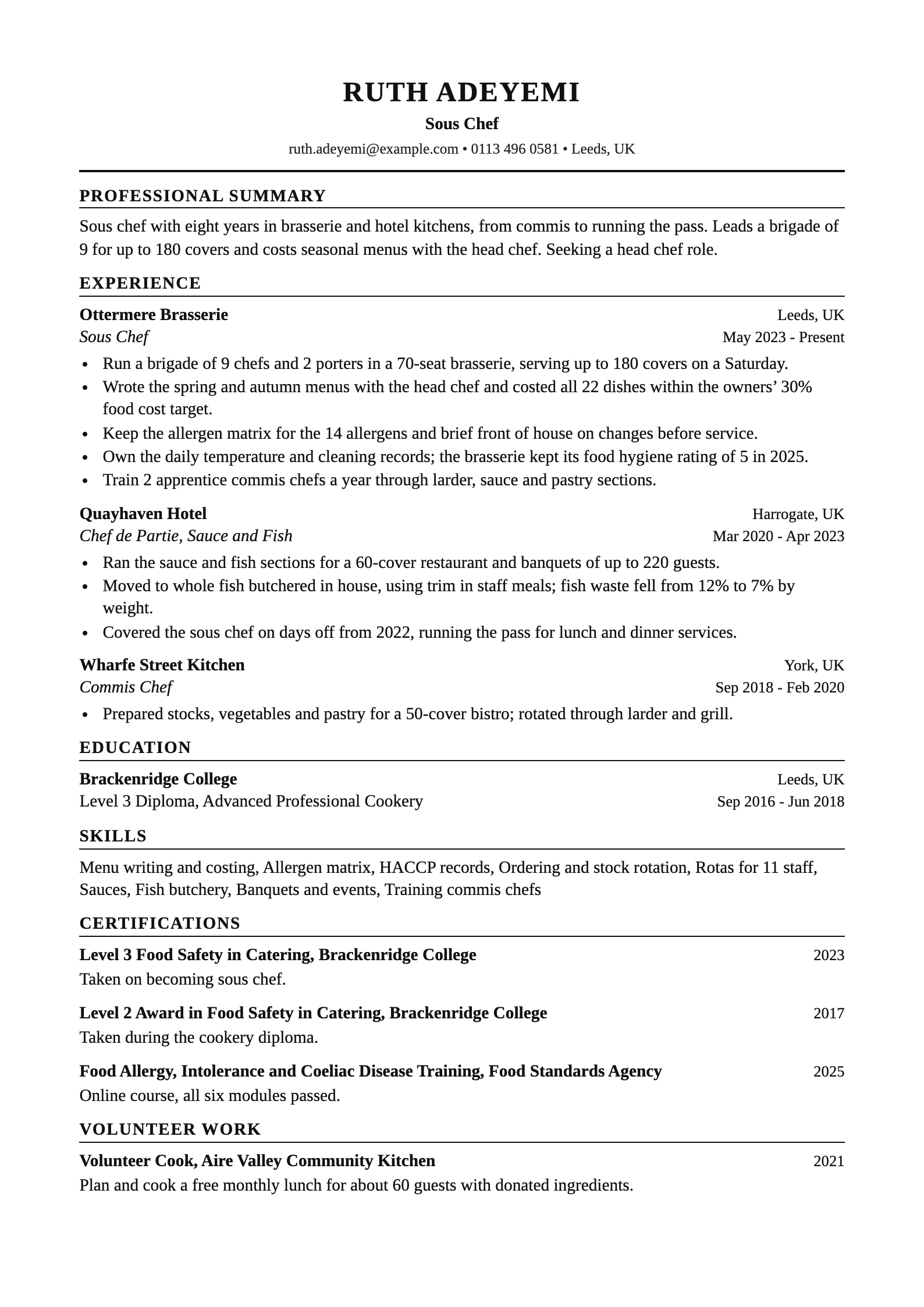
A complete chef CV in the Harvard layout
One page, one column, produced by our app. Ruth Adeyemi is fictional, and so are the employers, schools and figures. Read it for how the evidence is chosen and worded, then write your own.
Open this example as a PDF (47 KB)
Why this example is written this way
- Each kitchen is described by what a head chef needs to picture it: a 70-seat brasserie serving up to 180 covers on a Saturday, a 60-cover hotel restaurant with banquets of up to 220, a 50-cover bistro.
- The three roles show the brigade climb in order, commis chef, chef de partie and sous chef, and the bullet about covering the sous chef from 2022 shows the step up before the title changed.
- Costing is stated only as the candidate’s own work: 22 dishes costed within the owners’ 30% food cost target. If you never saw the costings, describe the menu work without a figure.
- The food hygiene rating of 5 is written as the brasserie’s rating, next to the records the candidate kept, not as a personal award.
- Food safety at Level 2 and Level 3 and allergen training each have their own line with the year, so a kitchen can check them before a trial shift.
Check your chef CV before you send it
On a chef CV, the review looks for bullets that list dishes or duties without the kitchen, covers or section behind them, a profile that claims head chef experience your roles do not show, kitchen jobs with missing dates, and food safety training buried below the skills.
The review needs no sign-in. Upload a PDF or Word (.docx) file to see what to fix first against the Harvard format, with weak bullets rewritten using only your own facts. We don't keep your CV unless you create an account. To work on a single line, paste it into the bullet rewriter for up to two rewrites that keep what you wrote.
What Hiring Managers Look For in a Chef CV
Head chefs look for proof that you can hold a section through a full service: the kind of kitchen, the covers, the brigade and what you ran on your own. Food safety training comes next, because the National Careers Service says a chef needs a food safety certificate and every food business must train or supervise its food handlers.[1][4][6]
Show the 5 pointsShow less
The size and style of each kitchen
A 40-seat bistro, a hotel with banqueting and a contract caterer feeding a hospital are different jobs. Give the style of food and the covers per service so a head chef can match your pace to theirs.
Where you sit in the brigade
Prospects describes a commis as entry level, a chef de partie as running one section, and a sous chef as second in command. Use the title you held, then show any time you covered the level above.[2]
Food safety and allergen knowledge
Kitchens must give customers allergen information for 14 named allergens, so a chef who keeps the allergen matrix and briefs front of house is useful from day one. Name the training and the year.[8]
Menu, ordering and costing work that was yours
Writing specials, costing dishes, ordering stock and cutting waste all show readiness for the next level. Say which parts you owned and which you supported.
Training others and reliability on shift
Sous chef and head chef roles involve supervising staff and running the kitchen when the head chef is away. Show apprentices or commis chefs you trained and services you ran alone.[1]
Chef CV Sections and Their Order
Open with a short profile naming your level and the food you cook, then kitchens in reverse order, then food safety and allergen training, skills, and college or apprenticeship training. One page suits most commis and chef de partie applications; a head chef can use two.
Show all 7 sectionsShow less
Contact details
Phone, email and town. Add a link to photos of your own dishes only if they are yours and the link opens without a login.
Profile
Your current title, the cuisine or style, the largest service you handle and the role you want, in two or three lines.
Experience
One entry per kitchen with the style and covers, then the sections you ran, menu or ordering work and anyone you trained.
Food safety and allergen training
Its own section, with the level or course title and the year, so a kitchen can check it before a trial shift.
Skills
Sections and techniques you can run unsupervised, plus ordering, rotas, costing and banqueting if you have done them.
Education and apprenticeships
College cookery diplomas or a chef apprenticeship with its level. Move it to the top when you are applying for your first kitchen job.
Languages
Worth a line for kitchens abroad, hotel groups and brigades where several languages are spoken.
How a Chef CV Changes With Experience
- No kitchen experience yet, or kitchen porter
- Lead with any food work you have done: kitchen porter or catering shifts, a college course, cooking for events or volunteering in a community kitchen. Put food hygiene training near the top and say which sections you would like to learn.
- Commis or chef de partie
- Give each kitchen its style, covers and brigade size, then the sections you ran and whether you ran them alone. Add one bullet each on prep, waste or quality you improved.
- Sous chef applying for head chef
- Bring menus you wrote, costing you owned, ordering, rotas and the chefs you trained to the top. Food safety records and inspections you prepared for belong here too, described as the business’s result.
Licences, Certifications and Registrations for Chefs
No licence is needed to cook professionally in the UK, and the law does not require a food hygiene certificate. Employers must still show that food handlers are trained or supervised for their work, and the National Careers Service says a chef needs a food safety certificate, usually from a short course.[1][4][5]
Show credentials by career stageShow less
Starting out (kitchen assistant, commis chef)
Level 2 Award in Food Safety in Catering
Issued by City & Guilds (one of several awarding organisations)
One example of the food safety certificate the National Careers Service says a chef needs; the law itself does not require one. Levels are set by awarding organisations, not by the Food Standards Agency, and regulated qualifications can be looked up on the government register.[1][4][7][13]
Food Allergy, Intolerance and Coeliac Disease Training
Issued by Food Standards Agency
Free online course of six modules, with a certificate when all six module tests are passed. The FSA says the certificate is not an official accreditation, so list it as training.[8][9]
Production Chef or Commis Chef Level 2 apprenticeship
Issued by Employer-led apprenticeships in England
Optional, paid route in that combines kitchen work with training.[1][2]
Level 2 Diploma in Professional Cookery
Issued by City & Guilds
Optional college route for people with some basic kitchen skills.[14]
Chef de partie and sous chef
Chef de Partie Level 3 apprenticeship
Issued by Employer-led apprenticeships in England
Optional. The standard gives a typical duration of 18 months and covers restaurants, hotels and care homes.[1][15]
Level 3 Diploma in Advanced Professional Cookery
Issued by City & Guilds
Optional. A kitchen and larder version is also offered.[14]
Training in HACCP principles
Issued by Awarding organisations and training providers
Needed by whoever develops and maintains the kitchen’s food safety management procedures. Not every member of staff needs it.[5][6]
Head chef or senior culinary chef
Senior Culinary Chef Level 4 apprenticeship
Issued by Employer-led apprenticeships in England
Optional. Built around developing new recipes, products and product lines, with a typical duration of 24 months before assessment.[1][16]
HNC or HND in Professional Cookery or Culinary Arts
Issued by Colleges in Scotland
Optional. Named by My World of Work among college routes for chefs in Scotland.[3]
Chef CV Keywords and Skills by Area
Use the terms the job advert uses, and only where a bullet, project or credential on your CV backs them up. Group them by area so a recruiter can scan the Skills section in seconds.
- Brigade and sections
- commis chefchef de partiesous chefhead chefsauce sectionlarderpastrygrillrunning the pass
- Service
- covers per serviceà la cartebanquetingtasting menubreakfast servicecontract cateringevents
- Food safety
- HACCPfood safety management systemtemperature recordscleaning schedulesallergen matrixPPDS labellingcross-contamination control
- Menu and kitchen management
- menu developmentdish costingstock orderingstock rotationwaste reductionsupplier liaisonrotas
- Techniques
- butcheryfish preparationstocks and saucesbread and pastryplant-based dishessous vide
Describe the kitchen before the dishes
A head chef reading your CV wants to picture the kitchen you worked in: the style of food, how many covers a service, the size of the brigade and the section you ran. Without that context, a list of dishes or techniques says little about whether you can cope with their pass on a Saturday night.
Keep commercial claims to what you can back up. Give a food cost or gross profit figure only if you set or tracked it yourself, and mention a hygiene rating as the business’s published rating rather than a personal award. Name food safety and allergen training with the level and year, because many kitchens ask for it before a trial shift.
Questions to answer before you write
- What style of food, how many covers and how big was the brigade?
- Which section did you run, and when did you cover a more senior chef?
- Which menu, costing or ordering work was yours rather than the head chef’s?
Strong and Weak Chef CV Bullets
A strong bullet names the work, the scope and what changed. These examples are fictional; use them for structure, not for their figures.
Show 4 bullet examplesShow less
Weak
Cooked food in a busy restaurant.
Strong
Ran the grill section alone on weekday services for a 90-cover steakhouse, cooking 120 to 150 steaks a night to order.
Why it works: It names the section, the kitchen size and the volume, which tells a head chef the pace you can hold.
Weak
Responsible for allergens.
Strong
Updated the allergen matrix for every menu change and briefed front of house at the pre-service meeting, so servers could answer allergen questions without leaving the floor.
Why it works: It shows the task, the routine and who relied on it, without claiming anything beyond the kitchen.
Weak
Helped reduce waste.
Strong
Cut bread waste by baking to the day’s bookings and turning leftovers into croutons and a bread pudding special.
Why it works: It gives the method and the result in kitchen terms, and needs no percentage the candidate cannot prove.
Weak
Trained new staff.
Strong
Trained 3 apprentice commis chefs on the larder section, signing off knife skills and prep lists before they worked a service alone.
Why it works: It gives a count, a section and a standard, which is what a head chef hiring a sous chef wants to see.
Common Chef CV Mistakes and How to Fix Them
Listing signature dishes with no kitchen, covers or section behind them.
Fix: Start each role with the kitchen’s style and covers, then say what you cooked and ran.
Writing “achieved a 5-star hygiene rating” as if it were a personal award.
Fix: Hygiene ratings are given to the business after a council inspection; write that the kitchen held its rating and say which records you kept.
Quoting a gross profit or food cost figure you did not set or see.
Fix: Use a figure only if you costed the dishes or tracked the numbers yourself; otherwise describe the menu work.
Leaving food safety training to the bottom of the page, without a level or date.
Fix: Give it its own section with the course title, level and year.
Calling yourself sous chef because you covered the role.
Fix: Keep your real title and add a bullet saying when and how often you ran the pass.
Career Changes and Gaps on a Chef CV
You can start without kitchen experience: the National Careers Service says many people begin as a kitchen assistant or trainee commis chef, and apprenticeships, college courses and university are other routes. A first chef CV leads with food hygiene training and any food or catering work you have done.[1]
Show the 5 pointsShow less
No experience yet
Put food safety training near the top, then any kitchen porter, café, catering or event shifts, and cooking you have done for groups. Say which sections you want to learn and when you can work.[1]
From front of house or hospitality
Waiting staff and bar staff already know service, allergen questions and pressure on a busy night. Describe what you saw of the kitchen and any food safety training you took for the role.
Through an apprenticeship
Commis chef and production chef apprenticeships start at Level 2 and are a paid way to train while you work. List the apprenticeship with its level, the employer and the expected end date.[1][2]
In Scotland
My World of Work names chef and production chef Modern Apprenticeships, a Foundation Apprenticeship in Hospitality at school, and college HNC or HND courses.[3]
Explaining a gap
Kitchens often see gaps between seasons or contracts. One line with the dates and the reason is enough; add any cooking, training or casual shifts from that time.
Chef CV Conventions by Country
Food safety rules for chefs differ by country, and so does the training an employer expects to see. Name your training in the terms of the country you are applying to, and keep your UK qualifications with their full titles.
Format conventions for every profession
- United Kingdom: Call it a CV and keep it to two A4 pages at most, with no photo. Leave out age, date of birth, marital status and nationality.[26][27]
- United States: Call it a résumé; it is usually more concise than a UK CV. Leave off a photo. Federal jobs allow two pages and ask for each job’s start and end month and weekly hours, but never your Social Security number.[26][28][29]
- Canada: Two pages at most; a photo is not the norm. Leave out age and marital status, and never include your Social Insurance Number.[30]
- European Union: Some employers ask for the Europass CV format, which suggests a photo; follow the advert and the country’s practice.[31]
What changes for chefs
- England, Wales and Northern Ireland
- Since 1 October 2021, food prepacked for direct sale must carry its name and a full ingredients list with allergens emphasised, known as Natasha’s Law. Display of food hygiene ratings is a legal duty in Wales and Northern Ireland but voluntary in England.[10][11]
- Scotland
- Scotland uses the Food Hygiene Information Scheme, where a business gets a Pass or Improvement Required, not a number. A REHIS Elementary Food Hygiene Certificate may be useful.[3][12]
- Ireland
- The Food Safety Authority of Ireland sets out the same duty for food businesses to supervise and instruct or train food handlers in food hygiene for their work.[17]
- United States
- The FDA Food Code, which states and localities choose to adopt, says the person in charge should be a certified food protection manager, and some states require a food handler’s certification. The American Culinary Federation’s levels run from Certified Culinarian through Certified Sous Chef and Certified Chef de Cuisine to Certified Executive Chef.[18][19][20]
- Canada (Ontario)
- A food service premises must have at least one food handler or supervisor who has completed food handler training on site during every hour it operates, so list your food handler certificate.[21]
Cover Letter Angle for chefs
A chef’s cover letter is short and practical: show you know the restaurant’s food, match your sections and covers to their kitchen, and offer a trial shift.
- Name something specific about their menu or style and link it to food you have cooked.
- Say which section you would run and the largest service you have handled.
- Mention food safety and allergen training if the advert asks for it.
- Give your availability for a trial shift and the shifts or split shifts you can work.
Use my chef CV and this job description. Write a concise one-page Harvard-style cover letter. Emphasize supported evidence from my CV, use the employer requirements, and do not claim skills I have not provided.
Chef CV Checklist Before You Send
- Every kitchen gives the style of food and the covers a service.
- Your title matches the one you held, and any time covering a senior chef is described as cover.
- Food cost or gross profit figures appear only where you set or tracked them yourself.
- A food hygiene rating is named as the business’s rating, with the year.
- Food safety and allergen training show the level and the year.
- Shift availability or right to work is stated if the advert asks for it.
For the layout itself, see the Harvard resume format in numbers, or start from the free Harvard CV template for Word.
Turn this guide into a finished Chef CV
Harvard CV Maker uses one strict Harvard-format document system. Upload your existing CV, paste notes, or build from scratch, then use AI to improve bullets, tailor to a job, and generate a matching cover letter.
Chef CV FAQ
Sources
Facts on this page about chef licences, certifications and country rules come from these public pages. Requirements change: check the issuing body before you apply.
- National Careers Service: Chef
- Prospects: Chef
- My World of Work (Skills Development Scotland): Chef
- GOV.UK: Running a food business: Staff training, illness and hygiene
- Food Standards Agency: Managing food safety
- legislation.gov.uk: Regulation (EC) No 852/2004, Annex II, Chapter XII: Training
- GOV.UK: Find a regulated qualification
- Food Standards Agency: Allergen guidance for food businesses
- Food Standards Agency: FSA Food Allergy Training
- Food Standards Agency: Introduction to allergen labelling for PPDS food
- Food Standards Agency: Food Hygiene Rating Scheme
- Food Standards Scotland: Food Hygiene Information Scheme business guidance
- City & Guilds: Food Safety in Catering (7150)
- City & Guilds: Professional Cookery (7100)
- Skills England: Chef de partie (ST0227)
- Skills England: Senior culinary chef (ST0864)
- Food Safety Authority of Ireland: Hygiene of Foodstuffs
- U.S. Food and Drug Administration: Food Code 2022
- U.S. Bureau of Labor Statistics: Chefs and Head Cooks: Occupational Outlook Handbook
- American Culinary Federation: Savory Certification Levels
- Ontario Ministry of Health and Long-Term Care: Food Premises Reference Document, 2019
- Food Standards Australia New Zealand: Standard 3.2.2A: Food safety management tools
- Food Standards Australia New Zealand: Safe Food Australia 2023: updated guide to Food Safety Standards
- training.gov.au: SIT30821 Certificate III in Commercial Cookery
- training.gov.au: SIT40521 Certificate IV in Kitchen Management
